Propane vs Natural Gas Outdoor Fireplace: Which to Buy
The fuel you choose for an outdoor fireplace affects your wallet, your installation timeline, and how often you actually light the thing. Propane and natural gas produce nearly identical flames and heat output, but they work very differently in practice.
Propane gives you flexibility. Fill a tank, connect it, and you're burning that evening. Natural gas ties you to a permanent line but costs significantly less per hour once that line is in. For most homeowners, the decision comes down to whether you own your space long-term and how often you plan to run the fireplace.
This guide covers both options honestly, including what real installation costs look like, how the per-hour math actually works out, and which products make the most sense depending on your setup.
Best Propane Outdoor Fireplace for Flexibility
The Endless Summer GAD1401G is the kind of fireplace you can set up on a Saturday afternoon without calling a plumber. It runs on a standard 20-lb propane tank, puts out 30,000 BTUs, and has a stacked slate surround that reads as permanent even though it's completely freestanding. If you're renting, if you move every few years, or if you want to avoid a gas line installation entirely, this is the realistic choice.
The trade-off is tank refills. At full burn, you're going through a 20-lb tank roughly every 8 to 10 hours. Running it three nights a week through summer means swapping tanks about once a month. That costs more per BTU than natural gas, but the gap is narrower than people assume, particularly if you're only burning it two to three hours at a time. For anyone who isn't sure how much they'll actually use a fireplace, starting with propane is the lower-risk call.
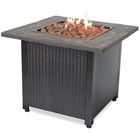
Endless Summer GAD1401G LP Gas Outdoor Fireplace
Check price on Amazon
3,800+ reviews
A freestanding propane fireplace with a real open flame and stacked slate surround that works on any patio without a gas line.
Shop on Amazon →Best Natural Gas Outdoor Fireplace for Permanent Patios
The Napoleon Riverside 42 is designed for homeowners who are building something that stays. It installs against an exterior wall or outdoor fireplace structure and runs on a dedicated natural gas line, producing a deep, wood-fire-style flame in a 42-inch opening. On a covered patio or outdoor living room, the visual weight of this fireplace changes the whole feel of the space in a way a portable unit simply cannot match.
Installation adds cost upfront. Expect to pay $300 to $600 for a gas line extension if one isn't already close to your patio, plus another $150 to $250 for the connection and pressure testing. After that, you're running the fireplace for roughly $0.80 to $1.20 per hour at current gas rates compared to $3 to $4 per hour for propane at the same output. Run it 100 hours a season and the installation cost pays back within two to three years. The calculation improves the more you actually use it.

Napoleon Riverside 42 Clean Face Outdoor Gas Fireplace
Check price on Amazon
1,100+ reviews
A 42-inch natural gas outdoor fireplace built for permanent installation with a clean, deep firebox and realistic flame.
Shop on Amazon →Best Propane Fire Column for Smaller Patios
On a 10x10 or 12x12 patio, a full mantel-style fireplace can take over the space and leave nowhere to actually sit. The Bond Manufacturing 52543 Fireglow fire column addresses that problem directly. It's a vertical propane fire feature, roughly 50 inches tall, that puts out 40,000 BTUs through a tempered glass enclosure. You can tuck it into a corner, position it beside a chair grouping, or place it at the edge of a deck without it dominating the layout.
The column format also makes propane more practical here. The 20-lb tank sits inside the base, hidden by the housing, so you're not looking at a green cylinder on the ground. For patios where a built-in fireplace doesn't make spatial or financial sense, this format gives you the flame, the warmth, and the ambiance at a fraction of the cost and zero permanent commitment.
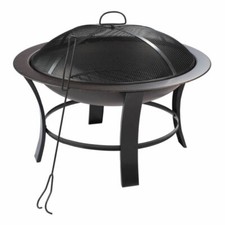
Bond Manufacturing 52543 Fireglow 26-Inch Propane Fire Column
Check price on Amazon
2,100+ reviews
A vertical propane fire column with concealed tank storage and a tempered glass enclosure built for compact outdoor spaces.
Shop on Amazon →Best Natural Gas Fire Table When a Fireplace Doesn't Fit
If you're leaning toward natural gas but a full outdoor fireplace exceeds your budget or footprint, the Sunnydaze 42-inch Natural Gas Fire Pit Table deserves a serious look. It runs on a permanent NG connection, produces 50,000 BTUs, and doubles as a functional surface when you drop the lid over the burner. For entertaining 6 to 8 people around a seating arrangement, the table format often works better than a wall-mounted fireplace because the heat and light radiate outward in all directions.
The practical case for natural gas here is identical to any permanent gas appliance. You turn a knob, it lights, and you never think about fuel again. No tank runs mid-dinner, no one asking where the propane is stored in the shed. For a patio that gets real use from spring through fall, that reliability has value that's hard to quantify until the first time you're entertaining and it just works.
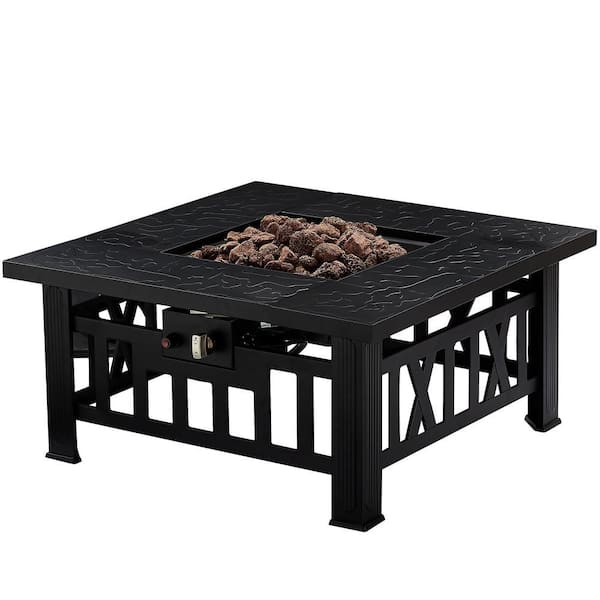
Sunnydaze Decor 42-Inch Natural Gas Fire Pit Table with Lid
Check price on Amazon
1,900+ reviews
A 50,000-BTU natural gas fire pit table with a convertible lid surface, built for permanent patio use and large gatherings.
Shop on Amazon →Quick Tips for Choosing Outdoor Fireplace Fuel
- Get a gas line quote before assuming propane is cheaper. A short line extension from an existing exterior connection often runs $300 to $400 total including labor. Many homeowners assume NG installation is expensive and go propane without ever checking.
- BTU ratings are comparable across both fuels. A 40,000-BTU propane fireplace produces essentially the same heat as a 40,000-BTU natural gas unit. The fuel type doesn't change the warmth output in any meaningful way.
- Propane makes more sense if you move every few years. Natural gas installations have a payback period that only works if you stay in the home for multiple seasons. Renters and frequent movers are almost always better served by a portable propane setup.
- Look for dual-fuel convertible models if you're undecided. Some outdoor fireplaces ship with conversion kits that let you switch between propane and natural gas by swapping orifice fittings. This is a reasonable hedge if you're building a new patio and aren't sure yet.
- Check local permit requirements before any gas line work. Most municipalities require a permit for new gas line installation. A licensed plumber handles the permit, but factor in a few weeks for inspection scheduling when planning your project timeline.
Frequently Asked Questions
Is propane or natural gas cheaper for an outdoor fireplace?
Natural gas is cheaper to run once the line is in place, typically $0.80 to $1.20 per hour versus $3 to $4 per hour for propane at comparable BTU output. The upfront installation cost for a gas line usually pays back within two to three seasons of regular use.
Can I convert a propane outdoor fireplace to natural gas?
Many models offer a conversion kit that includes different orifice fittings sized for natural gas pressure. Not every propane fireplace is convertible, so check the manufacturer specs before purchasing. The conversion must be performed by a licensed professional to stay within warranty and local code.
How long does a 20-lb propane tank last on an outdoor fireplace?
At a typical output of 30,000 to 40,000 BTUs, a 20-lb tank lasts roughly 8 to 12 hours of continuous burn. Running it two to three hours per evening, you'd refill once or twice a month during peak season.
Do outdoor propane fireplaces need to be vented?
Most freestanding outdoor propane fireplaces are ventless by design since they're used in open air. They should not be operated in fully enclosed spaces. If your patio is covered and screened on multiple sides, make sure there's adequate airflow on at least two open sides.
What BTU output do I need for an outdoor fireplace?
For open patios, 30,000 to 50,000 BTUs is the right range for most residential setups. Covered or partially enclosed outdoor rooms can often work well with 20,000 to 30,000 BTUs. Going higher doesn't necessarily mean more warmth if heat is escaping into open air around you.